
How do I check that the start-stop cable is tensioned correctly on my Petrol Lawnmower
Created by Chris McHale, Modified on Wed, 1 Jul at 11:08 AM by Chris McHale
The start-stop cable, also known as the engine brake cable, plays an important role in the safe operation of your petrol lawnmower. If the cable is too loose or too tight, the engine may fail to start, stop incorrectly, or the control lever may feel unresponsive.
This guide explains how to check and adjust the start-stop cable tension on your petrol lawnmower.
Quick Answer
If your petrol lawnmower will not start, does not stop correctly, or the start-stop lever feels loose, the engine brake cable may require adjustment.
A correctly adjusted cable should have approximately 5–10 mm of free play. If there is excessive slack, use the barrel adjuster on the cable to increase tension until the correct amount of movement is achieved.
Before You Begin
Before inspecting or adjusting the cable:
- Switch off the engine and allow it to cool completely.
- Remove the spark plug cap to prevent accidental starting.
- Place the lawnmower on a stable, level surface.
- Wear suitable personal protective equipment (PPE), including gloves.
Depending on your mower model, you may require:
- 8 mm and 10 mm spanners, or
- 10 mm and 12 mm spanners
Steps
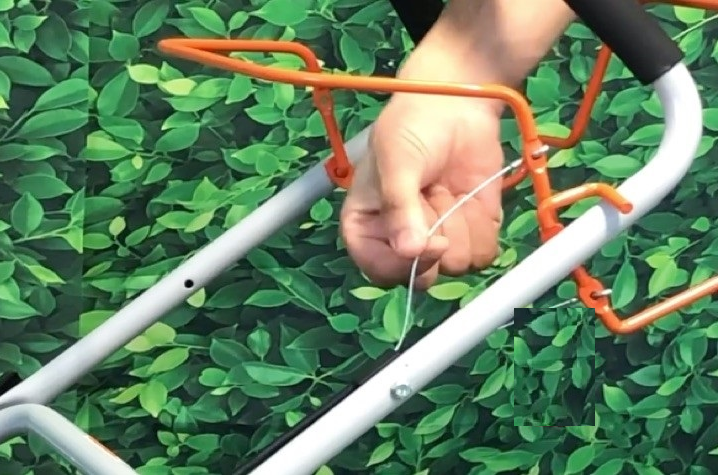
Step 1 – Check the Cable for Excessive Slack
Inspect the start-stop cable and check the amount of free movement.
The cable should typically have approximately 5–10 mm of free play.
Signs that adjustment may be required include:
- Excessive slack in the cable.
- The control lever feels loose or unresponsive.
- The engine will not start when the lever is held.
- The engine does not stop correctly when the lever is released.
If the cable has more than 5–10 mm of free movement, adjustment is recommended.
Step 2 – Locate the Cable Adjuster
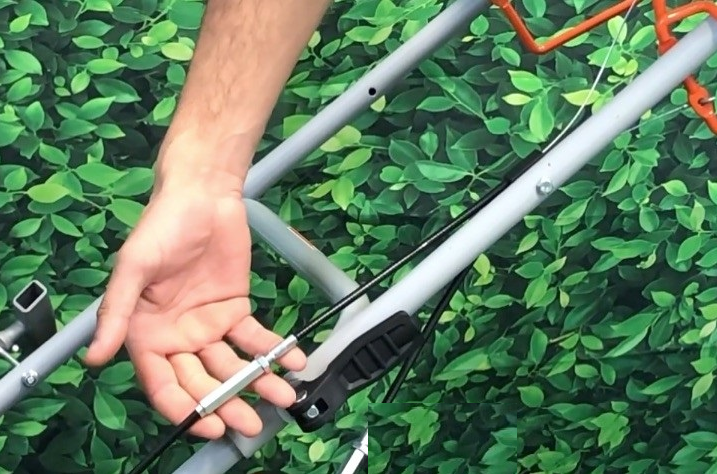
Locate the silver barrel adjuster positioned along the cable.
This adjuster is normally found approximately halfway down the cable and is used to increase or decrease cable tension.
Step 3 – Loosen the Locking Nut
Using the appropriate spanner:
- Hold the barrel adjuster in position.
- Loosen the locking nut.
- Do not remove the locking nut completely.
This will allow the adjuster to be turned.
Step 4 – Adjust the Cable Tension
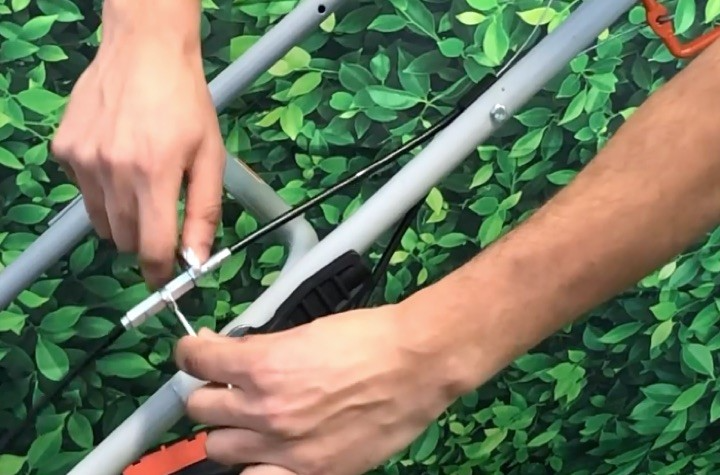
Turn the barrel adjuster to reduce the amount of cable slack.
Make small adjustments and check the cable movement regularly.
Continue adjusting until the cable has approximately 5–10 mm of free play.
Avoid overtightening the cable, as this can prevent the engine brake from operating correctly.
Step 5 – Secure the Adjustment
Once the correct tension has been achieved:
- Hold the barrel adjuster in position.
- Tighten the locking nut securely.
- Ensure the adjuster cannot move once tightened.
Step 6 – Test the Operation
After adjustment:
- Pull the start-stop lever and check that it moves smoothly.
- Release the lever and confirm it returns fully.
- Check that the cable moves freely without binding.
- Reconnect the spark plug cap.
- Start the mower and confirm normal operation.
Frequently Asked Questions
What does the start-stop cable do on a petrol lawnmower?
The start-stop cable connects the control lever on the handle to the engine brake mechanism. Holding the lever disengages the engine brake and allows the engine to run. Releasing the lever applies the brake and stops the engine.
How much free play should the cable have?
Most petrol lawnmowers require approximately 5–10 mm of free movement in the cable. Refer to your user manual if a specific adjustment is recommended for your model.
Can a loose start-stop cable prevent the engine from starting?
Yes. If the cable is too loose, the engine brake may not fully disengage when the control lever is pulled, preventing the engine from starting.
Can an overtightened cable cause problems?
Yes. A cable that is too tight may prevent the engine brake from operating correctly and could stop the engine from shutting down when the control lever is released.
How often should I check the cable adjustment?
It is good practice to inspect the cable at the start of each mowing season and whenever you notice starting issues, poor lever operation or excessive slack.
Was this article helpful?
That’s Great!
Thank you for your feedback
Sorry! We couldn't be helpful
Thank you for your feedback
Feedback sent
We appreciate your effort and will try to fix the article